AI Intelligent Agent in Action: 20+ Real Examples 2026

Key Highlights
Automation isn't enough:: Standard automation carries out tasks but cannot adjust or think.
AI Agents Take Over:: In 2026, AI intelligent agents are driving real outcomes across industries.
Beyond Chatbots and RPA:: Autonomous AI agents manage end-to-end workflows with speed and accuracy.
Agentic Advantage:: Intelligent agents in artificial intelligence boost ROI through smarter, data-driven operations.
The Future Is Agentic:: By 2027, most enterprises will run production-grade AI agents — the shift is now.
It's 2026, and the world of artificial intelligence looks very different. For some companies, the usage of simple chatbots has become a way of testing; they now use AI intelligent agents that are able to think, act, and learn as if they were digital coworkers.
Banks' everyday operations are supported by these autonomous AI agents: approving loans in a matter of seconds, prioritising patients via voice bots, and forecasting retail demand, for example, before stock runs out. Once limited to research labs, the intelligent agent in artificial intelligence has become a core driver of business efficiency and personalisation.
The shift is massive. McKinsey's 2025 State of AI report claims that more than 65% of companies globally are making use of AI agentic automation in one form or the other. Gartner went further by estimating that by 2027, 40% of large businesses will have smart AI agents working in production-grade environments with customer and internal processes.
In short, 2026 marks the inflexion point, where digital assistants evolve into truly intelligent partners. In the sections ahead, we'll explore 20 real-world applications of AI intelligent agents transforming industries from TechMonk's agentic platform.
What Is an AI Intelligent Agent and Why It Matters Now?
In simple terms, the AI intelligent agent is a digital system that can perceive information, make decisions, and act independently to achieve a goal.
Unlike traditional software, an artificial intelligence agent doesn't just follow a fixed script. It interprets real-time data, reasons through possible actions, and chooses the best one — sometimes even learning from the outcome. In essence, it's an autonomous AI agent designed to think and respond contextually, much like a capable human colleague.
There are several types of intelligent agents. Reactive agents respond directly to inputs; goal-based agents plan actions to meet objectives; utility-based agents weigh multiple options to maximise results; and learning agents continually refine performance through feedback.
When multiple smart AI agents collaborate across systems — from CRM tools to chat platforms — they form the foundation of modern, agentic automation, reshaping how businesses deliver personalised, data-driven experiences.
Why Businesses Are Betting Big on AI Agents
Behind every major digital transformation headline in 2026 lies one common force — the rise of the AI agent.
Companies are deploying fully autonomous AI agents with the ability to reason, make decisions, and collaborate as a result of the maturity of automation that leads them past chatbots and RPA.
As per MarketsandMarkets, the worldwide agentic AI market is expected to reach USD 140.80 billion by 2032 with a CAGR of more than 39.3%, which will be largely due to the deployment of intelligent agents in customer experience, finance, and operations. Likewise, Gartner has made a projection that by 2026, 40% of enterprise applications will have embedded task-specific AI agents as opposed to less than 5% today.
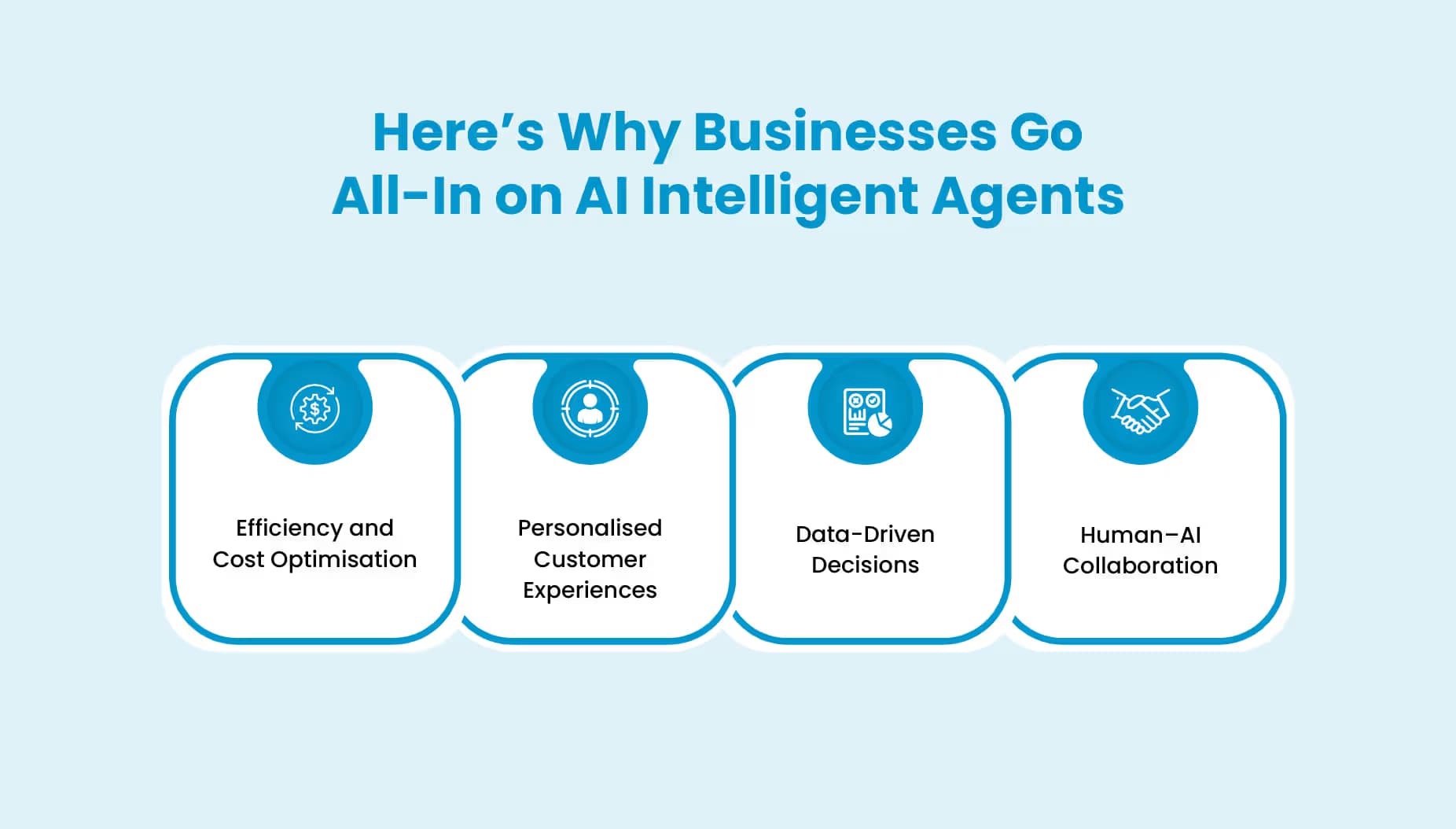
So why are businesses betting big?
- Efficiency and Cost Optimisation: Intelligent agents are capable of automating the tasks that are repetitive and based on rules, thus granting throughput time reduction and cost savings without sacrificing accuracy.
- Personalised Customer Experiences: A smart AI agent gets accustomed to every interaction, adjusting the dialogue and the suggestions made according to the particular person's needs, which leads to greater contentment and loyalty.
- Data-Driven Decisions at Scale: An AI-enabled intelligent agent, having continuous access to both organised and unorganised data, carries out the processes of trend analysis, outcome forecasting, and decision-making support for strategic options more quickly than human teams working together.
- Human–AI Collaboration: The new enterprise model isn't human or machine — it's both. Autonomous AI agents handle the execution layer while humans provide creativity, empathy, and oversight.
Together, these drivers explain why AI agents are quickly becoming a new form of digital capital — assets that scale intelligence across every business function.
20 + Real-World Examples of AI Intelligent Agents in 2026
Banking & Financial Services
From instant credit decisions to doorstep account openings, autonomous AI agents are transforming how financial institutions engage customers, manage risk, and drive compliance.
- Intelligent Lending Origination Agent: Built on TechMonk's agent flow, this artificial intelligence agent automates every step from pre-approval to e-sign. It analyses salary credits, checks affordability, and generates tailored offers, cutting decision time by 40% and reducing manual credit operations.
- Conversational Wealth & Micro-Investing Agent: A smart AI agent that delivers personalised portfolio advice, sets up SIPs, and explains risk–return scenarios in plain language. Banks using it report higher AUM and stronger retention among younger investors.
- Doorstep Banking Coordinator Agent: This intelligent agent in artificial intelligence schedules visits, verifies identity, and even cross-sells micro-insurance during appointments — blending digital convenience with human warmth.
- Financial Inclusion Agent: Designed for low-bandwidth regions, it onboards unbanked users through IVR and WhatsApp, guides KYC steps in local languages, and triggers micro-loans securely.
- Regulatory & Product Support Agent: Designed for low-bandwidth regions, it onboards unbanked users through IVR and WhatsApp, guides KYC steps in local languages, and triggers micro-loans securely.
- Dormant Account Reactivation Agent: Re-engages inactive customers via personalised nudges and instant KYC refresh, boosting reactivation rates by 3X and lowering acquisition costs.
Insurance — Intelligent Agents Redefining Customer Trust
In 2026, insurers are moving beyond chatbots and static portals.
They're adopting AI intelligent agents that streamline complex processes from claims to renewals — with speed, empathy, and compliance. By blending predictive analytics with conversational reasoning, these autonomous AI agents are redefining how insurance brands earn trust.
- Regulatory and Policy Support Agent: This agent utilizes RAG-backed policy knowledge to answer complex insurance questions, such as premium rules, exclusions, claim eligibility, tax implications, or surrender policies instantly and accurately. It can surface versioned regulatory snippets, cite policy documents, compare product benefits, and route complex queries to human agents with complete context.
- Reporting & Compliance Analytics Agent: This agent builds automated dashboards for insurance operations: claims turnaround time, fraud risk alerts, renewal cohorts, underwriting efficiency, and agent performance. It interprets natural language queries, automatically generates database queries, and displays results in tables and charts.
- Policy Renewal & Persistency Agent: This agent identifies customers nearing policy expiration, passively evaluates the chance of a lapse based on customer intelligence signals such as payment behavior, engagement, and claim history, and then proactively nudges them with personalized renewal offers. It also automates reminder processes, briefs customers on premium changes, and completes renewal OTP-based confirmation.
- Insurance Product Advisor & Coverage Matching Agent: This allows an agent to assist customers in finding the plan best suited for them (health, life, motor, or travel) by considering a few key parameters, such as family size, lifestyle, medical history (non-sensitive unless the user explicitly provides it), travel frequency, and budget.
Due to the combination of better automation and faster insights, insurance is no longer a tiresome and stubborn process; it has become a proactive, understanding, and analytic one instead.
Retail & E-Commerce — Personalisation at Machine Speed
If banking proves that AI can handle complexity, retail proves it can understand people. In 2026, leading brands are using the AI intelligent agent not just to automate, but to anticipate, knowing what customers want before they even type it.
- Personal Shopping Assistant Agent: This smart AI agent analyses browsing habits, past purchases, and even sentiment to curate tailored product selections. It becomes a virtual stylist, offering recommendations that feel intuitive and human.
- WhatsApp AI Agent: Whether it's verifying KYC in banking, processing a claim in insurance, scheduling medical appointments, or managing order updates in retail, the WhatsApp AI agent acts as a 24/7 digital concierge. Powered by real-time learning and an intelligent agent in artificial intelligence frameworks, it continuously improves with each conversation.
- Customer Re-Engagement Agent: When carts are abandoned, this artificial intelligence agent triggers contextual messages, perhaps a small discount or a product review through WhatsApp or email, recovering lost revenue with minimal human input.
- AI Reporting Agent: An AI intelligent agent can now perform all data consolidation, analysis, and visualization within seconds, so businesses need not take time juggling multiple dashboards or waiting for a manual report. This autonomous AI agent works with many data sources on a real-time basis, always staying in sync with the CRM, ERP, and marketing metrics. Users can ask questions in plain language — even in multiple languages — and the agent instantly generates accurate, context-aware responses.
- AI Support Agent: The agent provides post-purchase support, including order tracking, return handling, FAQ resolution, and ticket issuance as needed. It achieves this across web chat, WhatsApp, and email, to provide fast, consistent, automated service. Example: A customer asks, "Where is my order?" — the agent checks internal systems and responds immediately, or hands off the issue to a human if it is complex.
- Lead Generation Agent: The autonomous AI agent will engage visitors on the site, collect intent signals and leads, and nurture them to purchase. Often the chat initiates when the visitor lingers on the site, asks helpful questions ("Looking for something special?"), captures the visitor's email and/or phone, and passes the leads over to sales.
- AI Sales Agent: This AI bot serves as a digital sales assistant for your online store. It recommends products and deals with WhatsApp or chat interactions, such as nudging customers who've added items to the cart but haven't checked out. For instance, a shopper puts a pair of shoes into a cart and leaves. The bot immediately follows up with an in-chat message that offers a 10% discount on checking out accessories right in the chat.
Enterprise Operations — Where AI Intelligent Agents Work Behind the Scenes
Beyond customer-facing roles, AI intelligent agents are quietly transforming how enterprises operate internally. From onboarding new employees to monitoring compliance, these autonomous AI agents are reducing friction in every back-office process.
- Employee Onboarding Agent: This artificial intelligence agent guides new hires through digital induction, automates IT access, and personalises training plans. HR teams using such smart AI agents have reported up to 60% faster onboarding and markedly higher satisfaction scores.
- Compliance Monitoring Agent: An intelligent agent in artificial intelligence that continuously scans processes, communications, and audit trails for anomalies. It flags risks early, ensuring adherence to policies and saving compliance teams hours of manual checking.
- Data Governance Agent: This AI intelligent agent maintains data lineage, enforces access controls, and monitors data quality across systems — vital for companies scaling analytics securely.
- Sales Enablement Agent: A smart AI agent analyses customer interactions and CRM data to recommend next-best actions or cross-sell opportunities, helping sales teams focus on high-value leads.
In short, intelligent agents are fast becoming the invisible workforce — augmenting humans rather than replacing them, and turning operational intelligence into everyday efficiency.
Emerging Trends Shaping AI Intelligent Agents in 2026
With the adoption of AI accelerating, 2026 is going to be the year of the agentic enterprise, where networks of AI intelligent agents work together across various processes, learning and adapting continuously throughout the day.
- Rise of Agentic Platforms: Platforms such as TechMonk's Agent Builder are normalising access to autonomous AI agents. Businesses can now build, train, and deploy custom agents in weeks instead of months — transforming ideas into operational tools at speed.
- Multi-Agent Collaboration: The next frontier isn't a single smart AI agent, but ecosystems of agents that communicate and coordinate tasks autonomously from lead generation to fulfilment, creating truly self-optimising workflows.
- Embedded Trust and Explainability: Enterprises are demanding transparency. Tools like "TechMonk's Responsible AI — Trust Built-In" ensure that every intelligent agent in artificial intelligence logs its actions, decisions, and justifications for audit-readiness.
- Human–AI Harmony: Forward-thinking organisations now blend human judgement with machine precision. Humans define strategy and empathy; agents handle scale and repetition — a model that's proving both ethical and effective.
By 2027, Gartner, Inc. anticipates that organisations will increasingly rely on specialised, task-focused AI models, using them at a volume three times higher than general-purpose large language models (LLMs).
These trends signal a new era — not of replacement, but of collaboration between human ingenuity and autonomous intelligence.
TechMonk: Powering the Next Generation of AI Intelligent Agents
TechMonk is an AI agent-powered platform that helps you automate and improve every stage of customer engagement. It manages everything from acquisition to retention with ease.
What makes TechMonk stand out is its complete marketing toolkit. It brings customer data, segmentation, personalisation, and AI-powered campaigns together in one place to make your work simple. You may wonder how all of this comes together in one platform, and that is where TechMonk creates a clear difference.
You do not just deploy AI chatbots here. You deploy intelligent and task-oriented AI agents for e-commerce that think and act. Have you ever thought about AI agents that make real decisions?
These agents see, decide, and take action across different workflows. Each one learns from customer behaviour and analyses results. They also perform real tasks like following up, raising tickets, or even closing sales. Together, they make TechMonk a complete AI capital engine for your business.
Pre-Built AI Agents for Common Operations
TechMonk offers several pre-built AI agents that simplify daily operations. You can deploy them quickly without any coding or complex setup.
- AI Sales Agent:: The AI Sales Agent engages customers the moment they show interest. It shares personalised recommendations and instant quotes. This helps them make decisions faster and enjoy a simple and hassle-free process.
- AI Support Agent:: The AI Support Agent manages 24/7 customer service across multiple channels. It handles common queries with ease and raises tickets when needed. It also transfers complex issues to human agents. This improves efficiency, speeds up responses, and boosts customer satisfaction.
- AI Voice Agents:: AI Voice Agents provide natural and human-like conversations for inbound and outbound calls. They handle FAQs, appointment scheduling, and lead qualification with ease.
Build Your Own Agents with AgentMonk
AgentMonk, TechMonk's AI Agent Builder, lets you create, train, and deploy custom AI agents. These agents adapt to your workflows and goals. You can shape them the way you want, and this gives you more control.
- Tools Library:: TechMonk includes a ready library of tools, or you can build your own. These tools allow AI agents to take actions like raising tickets or completing customer requests.
- Agents Library:: Choose from many pre built AI agents for different engagement needs. You can also build a custom agent that fits your unique workflows and objectives.
- Agent Flow:: TechMonk ensures all AI agents work together smoothly. The Agent Flow assigns the right agent to each task and keeps every response fast and consistent.


Want to Build AI Agents in Just 3 Steps? • Choose Prebuilt Tools or Build Custom Tools • Choose Prebuilt AI Agents or Custom AI Agents • Build Custom Agentic Workflows to Automate Operations
Know MoreEnterprise Level Features
TechMonk includes enterprise-level features that keep your AI agents efficient and secure. You may wonder how your AI agents stay reliable over time, and these features handle that for you.
- Guardrails:: Guardrails keep responses accurate and safe. You set clear rules for inputs and outputs, and this prevents harmful replies and prompt hacking.
- Observability:: With observability, you track your agents in real time. You see how they interact and measure response quality.
- Traceability:: Traceability records every action your agents take. This brings accountability to all conversations and gives you insights to spot trends and improve results.
- Tracking AI Agent Performance:: TechMonk lets you evaluate how your agents perform. You can quickly find areas to improve and fine-tune your agents for better outcomes.
- Testing Automation:: Automated testing checks your agents before they go live. This helps fix issues early and ensures strong performance right from the start.
A Full-Stack Marketing Platform That Enhances TechMonk's Voice AI Agents
- Personalisation:: TechMonk's AI agents personalise every interaction using customer behaviour and preferences. From product recommendations to support queries, your agents deliver responses that feel tailored and relevant.
- Customer Data Platform:: The Customer Data Platform gives agents real-time access to customer information. They use purchase history, profiles, and multi-channel interactions to give accurate and context-driven replies.
- Behavioural Segmentation:: With behavioural segmentation, TechMonk's agents group customers based on actions like past purchases or engagement levels. This makes product recommendations and promotions more targeted and improves satisfaction and conversions.
See How Easy It Is to Build Your First AI Intelligent Agent With TechMonk.
Book DemoThe Future Outlook — AI Intelligent Agents as Business Capital
AI is no longer just a technology investment; it's becoming a form of digital capital.
The businesses will be transforming to the point where the agentic Workflows will be the standard. This means that the human, data, and AI agent trinity will be working together seamlessly. The agents will handle the rule-based routine tasks, allowing human employees to spend their time and use their talents in the areas that require creativity, strategic thinking, and empathy.
The value proposition is clear: intelligent agents don't replace human capital — they amplify it. They create compound efficiency: every agent that gets trained, becomes better, and shares knowledge, increasing the overall intelligence of the company.
Conclusion
The progress from simple chatbots to the sophisticated AI intelligent agents has been rapid and nothing less than a revolution. Across banking, insurance, and retail, these agents are reshaping the way we work, engage, and decide.
The takeaway for executives is obvious: AI intelligent agents are not a futuristic concept — they're operational today, driving measurable gains in efficiency, customer experience, and innovation.
As 2026 unfolds, the companies that will come out on top will be those that combine human artistic input with AI agents, working in an AI system like TechMonk that has both autonomy and accountability.
Design, Deploy, and Scale Your Own AI Agents with TechMonk.
Request DemoFrequently Asked Questions
Have another question? Please contact our team!
An AI intelligent agent perceives data from the surroundings, analyses it through machine learning or reasoning models, and takes independent actions to realise a goal. All the while, it is learning from the results of its actions and is getting better at its decision-making with each interaction.