Autonomous AI Agents: A Game-Changer for CX in Financial Services

Key Highlights
Changing Expectations: Customers demand smooth digital journeys and quick support across channels.
Core Challenges: Broken journeys, inactive accounts, rule pressure, high cost, and service gaps slow growth.
AI Solutions: AI improves journeys, automates tasks, lifts retention, and strengthens compliance.
Lifecycle Impact: AI enhances acquisition, engagement, retention, and community access across all touchpoints.
The way your customers expect to interact with financial services is changing fast. Are you prepared for this shift?
Just look at the numbers.
- 65% of consumers say they'll switch banks for a better experience
- 81% want a smooth, consistent journey across every channel.
Meeting these expectations isn't easy, especially with rising competition. So how do you deliver the kind of experience today's customers actually want?
Key Challenges in Customer Engagement
Financial institutions deal with many challenges that slow down their ability to deliver smooth customer engagement. These issues affect growth and also pull down staff output and customer satisfaction.
1. Fragmented Customer Journeys
Customers reach you through many channels, like branches, mobile apps, WhatsApp, and call centres. This creates broken customer journeys. It often leads to different experiences in each touchpoint. This leaves customers confused and disconnected from your brand.
2. Dormant and Under-engaged Accounts
Many accounts stay inactive for long periods. This makes you miss clear chances for cross selling and upselling. These inactive accounts reduce revenue potential. You try to bring these customers back, but the effort does not always give good results.
3. Complexity of Regulatory Compliance
Rules from bodies like the RBI change all the time. You need to stay updated in real time. Manual work does not keep pace with these updates. This increases the risk of rule breaks and also slows down operations.
4. Low Staff Productivity and High Operational Costs
Teams spend a lot of time on repeated tasks like onboarding, customer support, and manual outreach. These tasks raise customer acquisition costs. They also push your teams to juggle many things at once. This takes their attention away from high-value work.
5. Rising Expectations for Digital Service
Customers today expect support at any time of the day. They also want help in their own language and on the platforms they use the most. Traditional support setups do not scale well. This leaves clear gaps in service and leads to unhappy customers.
6. Financial Inclusion Gaps
Rural and underserved groups still lack good access to digital tools and basic financial knowledge. This blocks their path to financial inclusion. These groups lack the services they need to improve their lives.
How Do AI Agents Solve These Bottlenecks?
AI agents help you solve these challenges with speed and clarity. They support your teams and lift customer engagement across all touchpoints. Let us look at the benefits of autonomous intelligent agents.
1. Unified and Smooth Journeys
AI agents offer one clear and personal experience across all channels. They support customers on apps, WhatsApp, and even in branch visits. No matter where the customer starts, the service feels steady and personal.
2. Scalable Efficiency
AI agents take over repeated tasks like onboarding, support, and document checks. This gives your teams more time to focus on work that needs deeper attention. It also lowers customer acquisition costs and lifts overall output. You manage bigger volumes without extra cost.
3. Proactive Retention and Revenue Growth
AI agents study customer behaviour and spot inactive accounts or lost revenue chances. They then reach out with personal offers. This turns missed chances into real growth.
4. Always On, Multilingual Support
AI agents let you offer support around the clock in many languages. This meets the needs of the modern customer who stays connected at all hours.
5. Embedded Compliance Guardrails
AI keeps your operations in line with the latest rules. It automates checks and reduces human errors. This lowers the risk of rule breaks.
6. Deep Financial Inclusion
AI agents support underserved groups through voice-based help and support in local languages. This improves access and lifts financial inclusion for those who need it the most.
| Fragmented Customer Journeys | Unified Journeys: Consistent, personalised experiences across all channels. |
| Dormant Accounts | Proactive Retention: AI detects and re-engages inactive accounts with offers. |
| Regulatory Compliance | Compliance Guardrails: Automates checks to ensure real-time rule adherence. |
| Low Productivity & High Costs | Scalable Efficiency: AI automates repetitive tasks, freeing up staff for more value-driven work. |
| Rising Digital Expectations | 24/7 Multilingual Support: AI meets customer demands for round-the-clock service. |
| Financial Inclusion Gaps | 24/7 Financial Inclusion: AI assists underserved groups with voice and local language support. |
How AI Agents Improve Engagement Throughout the Customer Lifetime in BFSI
AI agents improve engagement across every stage of the customer lifecycle. They support you from acquisition to retention and help you build steady profit. You may wonder how they do this across so many touchpoints.
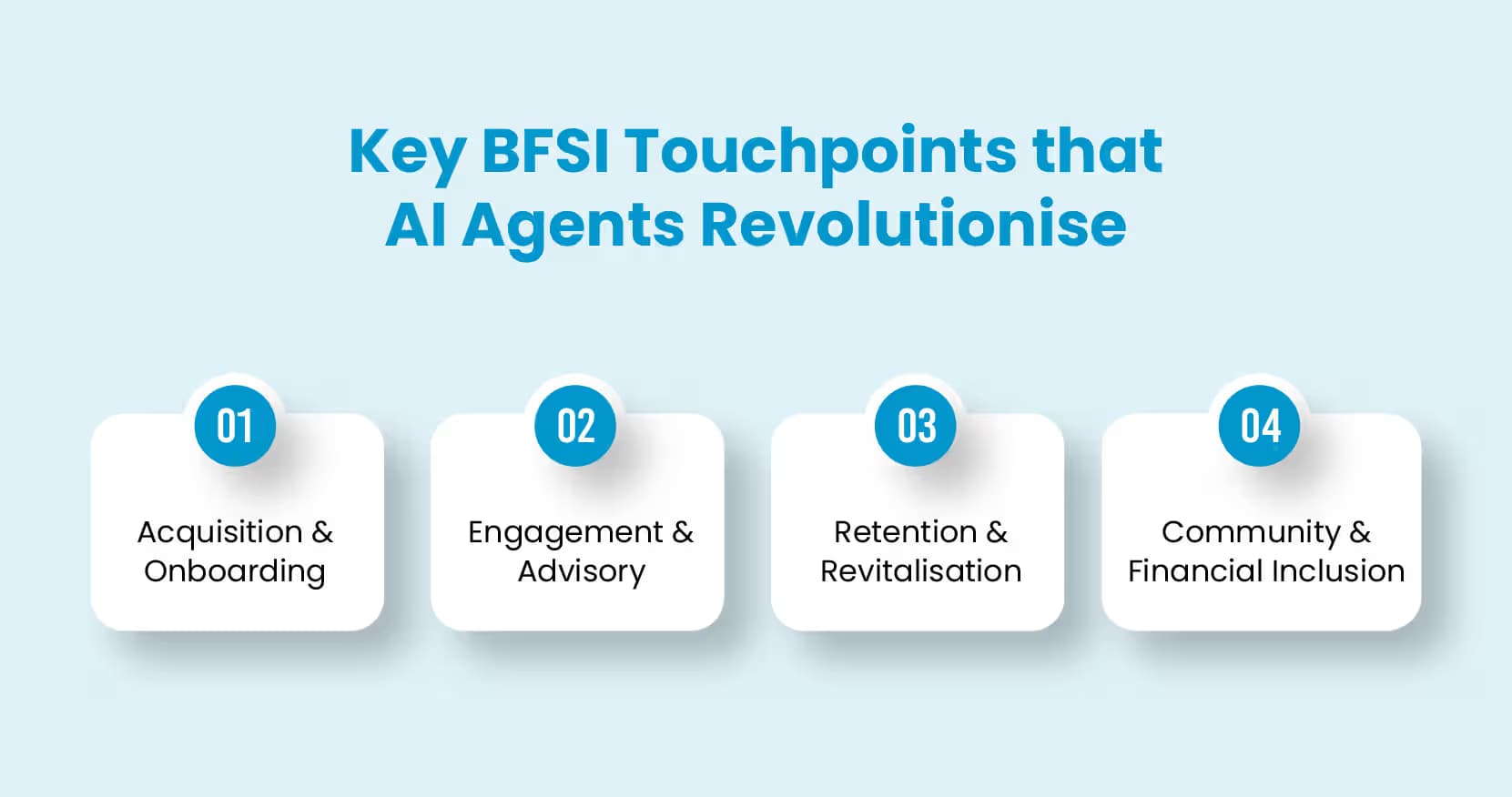
1. Acquisition and Onboarding
AI agents make the acquisition process smooth. They support lead generation, speed up onboarding and shape every interaction in a personal way.
- Smart Lead Generation: AI scans digital, social and internal data to find strong prospects. It then sends personal outreach through WhatsApp, SMS or voice calls. This gives each person a clear and personal start.
- Real Time Micro Segmentation: AI agent builds very focused segments with real-time data such as location, transaction history and customer details. This flexible segmentation makes each experience more relevant and increases the chance of conversion. You already know how hard it is to keep offers relevant without this kind of support.
- AI Driven Onboarding: AI handles checks like KYC, document capture, validation and digital signatures through simple chats. This gives new customers a smooth start and reduces early friction.
- Financial Learning Bots: AI agents support many languages. They share simple learning tools with first-time customers and also guide them through fun onboarding tasks. These bots help younger groups or underserved groups understand basic money skills and stay more engaged.
- Eligibility Check: AI checks customer eligibility for different financial products in a quick and simple flow. It guides each person toward the right option. This reduces application drops and brings more successful signups.
2. Engagement and Advisory
After onboarding, AI agents stay active. They offer personal advice, financial guidance and relevant product ideas. This lifts engagement without putting more load on your team.
- Conversational Product Advisors: AI product advisors suggest personal financial solutions like savings accounts, insurance plans or loans. They match these suggestions with life events, customer actions and changing needs. These early suggestions hold customer interest and improve product use.
- Personal Nudges: AI sends timely reminders for bill payments, loan dues and other tasks through the customer's preferred channel. These small nudges keep customers on track.
- Goal-Based Savings Assistant: AI helps customers set and track clear financial goals, such as recurring deposits or fixed deposits. It also encourages seasonal top-ups. This builds steady engagement and better saving habits.
- Multilingual Customer Education: AI explains complex financial products and digital steps in local languages. This makes services easier to understand for diverse groups and supports stronger financial access.
- Cross-Sell and Upsell Optimisation: As customer needs grow, AI offers relevant options like gold loans, small insurance plans or simple investments. This increases revenue through better cross-sell and upsell decisions.
- Real Time Feedback Capture: AI collects instant customer feedback that helps your team act fast. It also alerts your team when a human touch is needed. This real-time insight helps you improve service quality.
3. Retention and Revitalisation
AI agents help you keep customers active in the long run. They also revive dormant accounts and shape early interventions.
- Dormant Account Detector: AI detects inactive accounts and sorts them based on behaviour and risk. It then builds personal recovery plans with clear offers and suggestions.
- Automated Winback Outreach: AI agent sends personal winback messages or gentle prompts through WhatsApp, SMS or voice. These messages bring inactive customers back and restore lost revenue.
- Preventive Engagement: AI agent shares account health updates, fraud alerts and simple transaction advice. This keeps customers informed and prevents issues before they grow. It also strengthens loyalty.
- Bulk Notifications and Compliance Alerts: AI agent delivers personal updates on rate changes, scheme updates and rule changes. This helps customers stay informed and aware of important legal updates.
- Customer Journey Analytics: AI agent tracks every stage of the customer lifecycle and sends timely guidance. It offers personal retention ideas when a customer shows signs of stepping away. This approach protects lifetime value.
4. Community and Financial Inclusion
AI agents play an important role in reaching underserved groups. They build strong community ties and help more people access financial services.
- Micro Credit and Rural Lending Agents: AI agents support small loan origination for groups like small farmers or self-help groups. Simple voice support in local languages reduces barriers to money access.
- Financial Learning and Digital Access: AI literacy programs run through WhatsApp or voice in local languages. These programs improve digital onboarding and teach core financial basics.
- Community Engagement and Member Services: AI agents help with community meetings, issue handling, and real-time updates on offers or rule changes. This builds trust and a deeper connection.
- Local Merchant Integration and Ecosystem Growth: AI agent supports local merchants with digital payments, simple help and loyalty programs. This strengthens the larger ecosystem around financial institutions.
- Access and Inclusion: Voice-first AI flows with low data needs to help people without smartphones or reading skills. These simple prompts support financial independence for underserved groups such as pensioners, women, and young people.
TechMonk: The Go-To Platform for Building AI Agents That Perform
TechMonk is an AI agent-powered full-stack customer engagement platform that helps you automate and manage every stop of the customer journey, from acquisition to retention. You may wonder what makes TechMonk stand out. The reason is simple. It gives you a complete marketing toolkit. You get customer intelligence, segmentation, personalisation, and smart campaigns in one place. All these parts work together and make your work much easier.
With task-focused AI agents, TechMonk handles all repeated tasks so your team can instead focus on the work that matters most. These agents stay smart and can think, decide, and act on their own. They learn from customer behaviour and study results to handle tasks like follow-ups, support ticket creation, and even closing sales. In short, TechMonk turns into your business AI capital engine.
Key Features of TechMonk's AI Agents
- WhatsApp and Voice Interactive Agents: They handle FAQs, transactional support, and issue resolution on the user's preferred platform, whether it is WhatsApp or voice. This makes onboarding easy for elderly customers or users who feel unsure about digital steps. It also supports regional languages.
- Smooth Human Escalation: When the AI agent faces a complex issue, it flags it and sends the case with full context to your support team for a faster and more caring response.
- Conversation Memory: AI agents remember past chats, preferences, and pending issues. This helps them offer follow-ups with full context and send timely reminders.
- Round-the-Clock Availability: TechMonk gives quick responses to urgent queries like blocked accounts or forgotten PINs. This removes long wait times.
- Smart Satisfaction Tracking: Post interaction surveys, NPS scoring, and feedback collection run on their own. They also link with your CRM so you can track and improve your support quality.
How Do You Build AI Agents With TechMonk?
Building AI agents with TechMonk is simple and takes three steps. You may ask how the setup works in your workflow.
1. Tools Library: Choose from ready tools or create your own so your AI agents have everything they need to handle any task in your workflow.

2. Agents Library: Pick ready agents or build custom ones. They can use your tools or the tools already available in the library.

3. Agent Flow: Automate your workflows by giving tasks to the right agents. The orchestrator in TechMonk makes task assignment smooth and clear.
What Makes AI Agents Built with TechMonk Stand Out?
- Explainable and Transparent Agents: Every decision, from loan approvals to rejections, comes with a clear reason and a digital footprint. This stays ready for internal and RBI audits.
- Enterprise Grade Control: With AgentMonk, you can track, train, and improve your AI agents in real-time. You do not need any technical skills for this.
- Tracking AI Agent Performance: You can measure performance, reasoning, response time, and latency. This helps you improve your agents all the time.
- Conversation Trace: Track your agents across channels and spot areas that need improvement.
- Strict Guardrails: Set input and output limits so agents accept only valid inputs and give accurate responses. This avoids misuse.
- Full Observability: Watch your agents in action and find issues early so you offer a smooth customer experience.
- Testing Automation: Test, train, and fine-tune your agents anytime. LLM Judge checks responses and helps you ensure accuracy and relevance.
How Do TechMonk's AI Agents Stay Intelligent?
TechMonk's AI agents stay smart and flexible. You may wonder what supports this level of intelligence.
- Customer Intelligence Platform: Build a full view of your customers. Combine profiles, financial behaviour, and engagement history to offer smarter and more personal service.
- AI-Driven Campaigns: Launch targeted campaigns with ease. You can personalise offers based on age, location, and behaviour to increase engagement.
- Journey Builder: Create smooth and personal customer journeys that feel natural and relevant. This helps you connect with different customer groups in a more effective way.
Conclusion
Are you ready to unlock the full potential of autonomous AI agents for your financial services?
Adopting AI agents helps you streamline customer engagement, reduce costs, and stay compliant with ease. They tackle key challenges, improve efficiency, and boost customer satisfaction.
Without them, you might be missing out on huge opportunities in a competitive market. Don't let your competition pull ahead. Take the next step and start building your AI agents with TechMonk today.
Take the Lead With AI Agent-Powered Customer Engagement.
Build My AI Agent NowFrequently Asked Questions
Have another question? Please contact our team!
Autonomous AI Agents work as smart systems that handle tasks without human help. They process data, make choices and take action in real time. You may wonder how they adapt so fast to changing situations. They keep learning as they work and improve their performance over time. This makes them a strong fit for areas that need both speed and accuracy.