AI-Driven Customer Intelligence & Hyper-Personalisation in E-commerce

Key Highlights
Beyond Data: Customer intelligence turns raw events into a clear understanding of intent and context.
Real-Time Decisions: Actions adapt while customers browse, compare, and purchase, not after.
Personalisation Gaps: Fixed rules, static personas, and delayed insights break relevance.
AI Intelligence: Unified signals create adaptive, context-aware experiences across journeys.
Business Impact: Higher conversions, stronger loyalty, better order value, and efficient marketing spend.
Is your current personalisation strategy keeping up with real-time customer behaviour?
Customer expectations continue to rise, and personalisation now plays a central role in how you drive growth. Today, 81% of customers expect experiences that reflect their individual needs. This shift changes how you plan engagement.
Personalisation delivers clear business impact:
- Cut down customer acquisition costs by up to 50%
- Increase revenue by 5% to 15%
- Boost marketing ROI by 10% to 30%
In this blog, you will explore how AI-driven customer intelligence strengthens personalisation at scale.
You will see how it differs from traditional approaches and learn how to build more relevant and meaningful experiences that support long-term business growth.
What Customer Intelligence Means for E-commerce Teams
Customer intelligence is often misunderstood in e-commerce. Many teams assume they already have it because they collect large volumes of customer data. But having data is not the same as understanding customers. This gap is where most personalisation efforts fall apart.
How Does Customer Intelligence Differ From Customer Data
Every e-commerce brand collects customer data. This includes events, transactions, clicks, browsing behaviour, and customer profiles. Data shows what users did on a website or app.
However, data by itself is passive. It sits in analytics tools and reports. It records activity, but it does not guide decisions.
This is where customer intelligence comes in. Customer intelligence adds meaning to data. It helps teams understand intent, context, and what action makes sense next.
Instead of asking what happened, customer intelligence helps answer:
- What is the customer trying to do right now?
- Are they exploring, comparing, or ready to purchase?
- What is the most relevant experience to show at this moment?
Because of this, data alone cannot drive personalisation. Personalisation needs clear direction. Without intelligence, experiences remain generic and disconnected.
How Customer Intelligence Differs from Customer Insights
At this point, many teams rely on AI-driven customer insights.
Insights explain patterns after events have already occurred. They show what worked, what didn't, and where users dropped off.
While insights are useful for reviews and planning, they are always backwards-looking.
Customer intelligence works differently.
It supports decisions while the customer is still active. It helps teams decide, in real time:
- Which product to recommend next
- Whether to engage now or wait
- How to adapt the journey as behaviour changes
This distinction matters because e-commerce personalisation is time-sensitive. If decisions arrive late, relevance is lost.
Customer intelligence bridges this gap. It turns understanding into timely action. And timely action is what makes personalisation feel relevant, consistent, and effective.
Why Traditional Personalisation Approaches Fall Short?
Most e-commerce personalisation still relies on old methods. These approaches worked when customer journeys were simple. Today, they struggle to keep up.
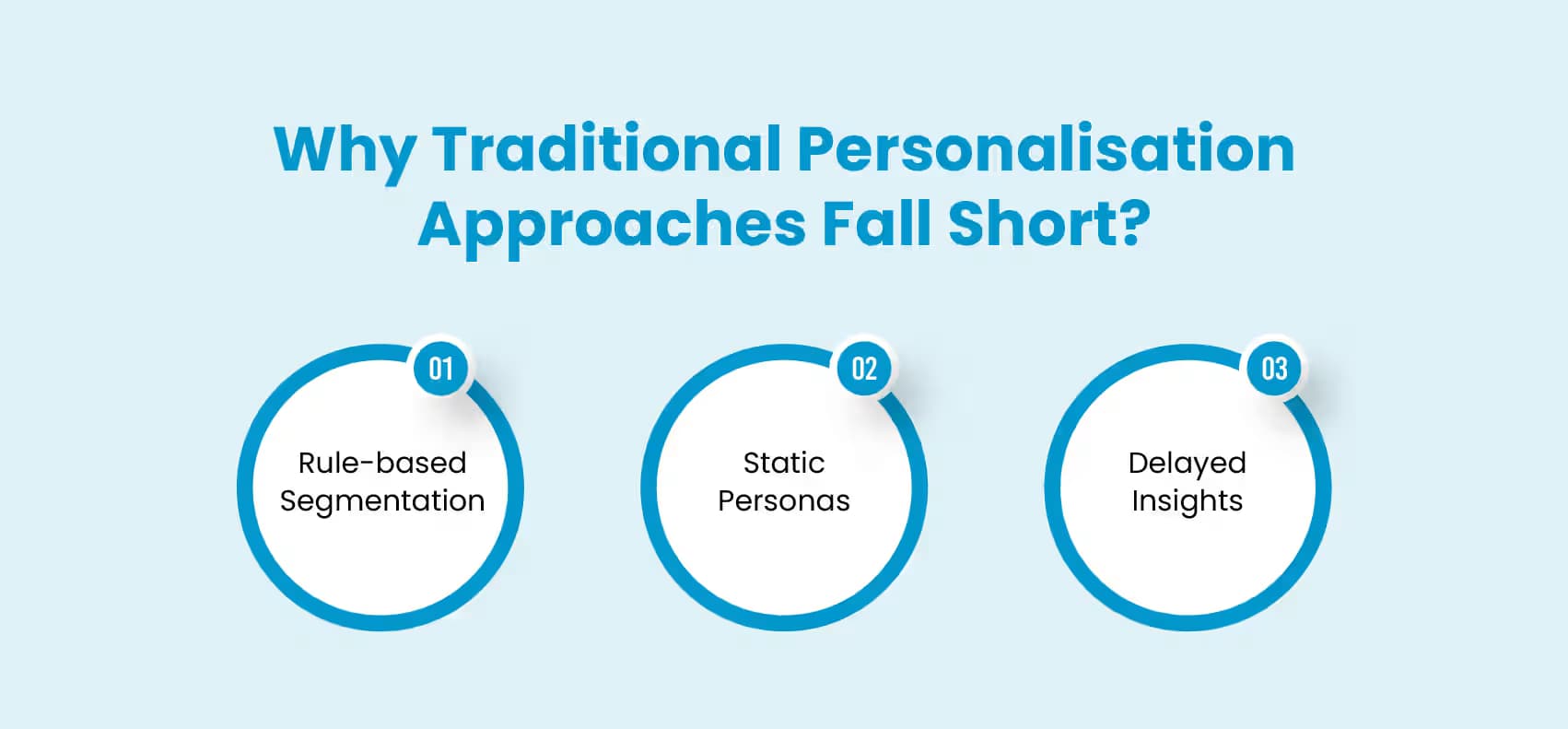
1. Rule-based Segmentation
Teams create rules like "show this offer to returning users" or "send this message after three visits." These rules are fixed. They don't adapt when customer behaviour changes. As a result, personalisation feels repetitive and predictable.
2. Static Personas
Personas are built from past data and assumptions. But real customers don't behave the same way every time. Their intent changes based on context, timing, and needs. Static personas cannot reflect this dynamic behaviour.
3. Delayed Insights
Most personalisation decisions are based on reports from yesterday or last week. By the time insights are available, the moment to act is already gone. This leads to missed opportunities during browsing, checkout, or post-purchase stages.
All these gaps point to the same issue. Traditional personalisation lacks intelligence. And without intelligence, relevance breaks.
How Does AI-Driven Customer Intelligence Improve Personalisation?
AI-driven customer intelligence changes how personalisation works. Instead of relying on fixed rules and delayed data, it focuses on understanding customers in real time and acting accordingly.
Turning Fragmented Data into a Unified Customer Understanding
E-commerce data comes from many places. Browsing behaviour, transactions, engagement, and support interactions all live in separate systems.
AI-driven customer intelligence brings these signals together.
It creates a single, evolving view of each customer. This view updates as behaviour changes. Personalisation decisions are no longer based on isolated events. They are based on the full customer context.
This unified understanding makes personalisation more accurate and consistent.
Real-Time Intelligence for In-Moment Personalisation
In e-commerce, timing matters. Showing the right message too late has no value.
Real-time customer intelligence helps teams act while the customer is still active. It enables decisions during key moments, like browsing, comparing, or hesitating at checkout. This is what makes personalisation feel relevant instead of intrusive.
From Rule-Based to Adaptive Personalisation
AI-driven personalisation does not depend on fixed rules. It learns from behaviour and adjusts continuously.
As customers interact, the system adapts recommendations, content, and journeys. Personalisation responds to what customers do, not what rules assume they will do. This shift makes personalisation more flexible, accurate, and effective at scale.
Personalisation Use Cases Enabled by Customer Intelligence
Customer intelligence improves personalisation by improving decisions. Instead of guessing what might work, teams can respond to real behaviour and intent. Below are the most common personalisation use cases where this shift makes a clear difference.
Personalised Product Discovery and Recommendations
Many shoppers visit without knowing exactly what they want. Customer intelligence helps understand browsing signals, past behaviour, and current intent. Based on this, product discovery becomes easier. Recommendations feel relevant, not random. Customers see products that match their needs at that moment, which reduces friction and speeds up decisions.
Context-Aware Engagement Across Channels
Customers move between channels. They browse on mobile, compare on desktop, and return via email or ads. Customer intelligence keeps context consistent across these touchpoints. Messaging adapts based on where the customer is in the journey. This avoids repeated or irrelevant communication and creates a connected experience.
Journey-Based Personalisation
Traditional personalisation often focuses on one action at a time. Customer intelligence looks at the entire journey. It adjusts experiences as customers move from discovery to purchase and beyond. Each interaction builds on the last one. This makes personalisation feel natural and continuous, not forced.
Predictive Personalisation
Customer intelligence also helps predict what might happen next. It identifies customers likely to return, pause, or drop off. Based on this, brands can personalise follow-ups, recommendations, or incentives. This proactive approach strengthens retention and encourages repeat purchases.
Across all these use cases, the key difference is decision quality. Better decisions lead to better personalisation outcomes.
How Better Personalisation Translates to Business Outcomes
When personalisation improves, business metrics follow. Customer intelligence connects personalisation directly to results.
Relevant experiences lead to higher conversion rates. Customers find what they want faster and with less effort.
Smarter recommendations increase average order value. Customers discover products that genuinely match their needs.
Consistent and timely experiences improve repeat purchase behaviour. Customers feel understood and are more likely to return.
Finally, better decisions reduce waste. Brands spend less on irrelevant messages, leading to more efficient marketing spend.
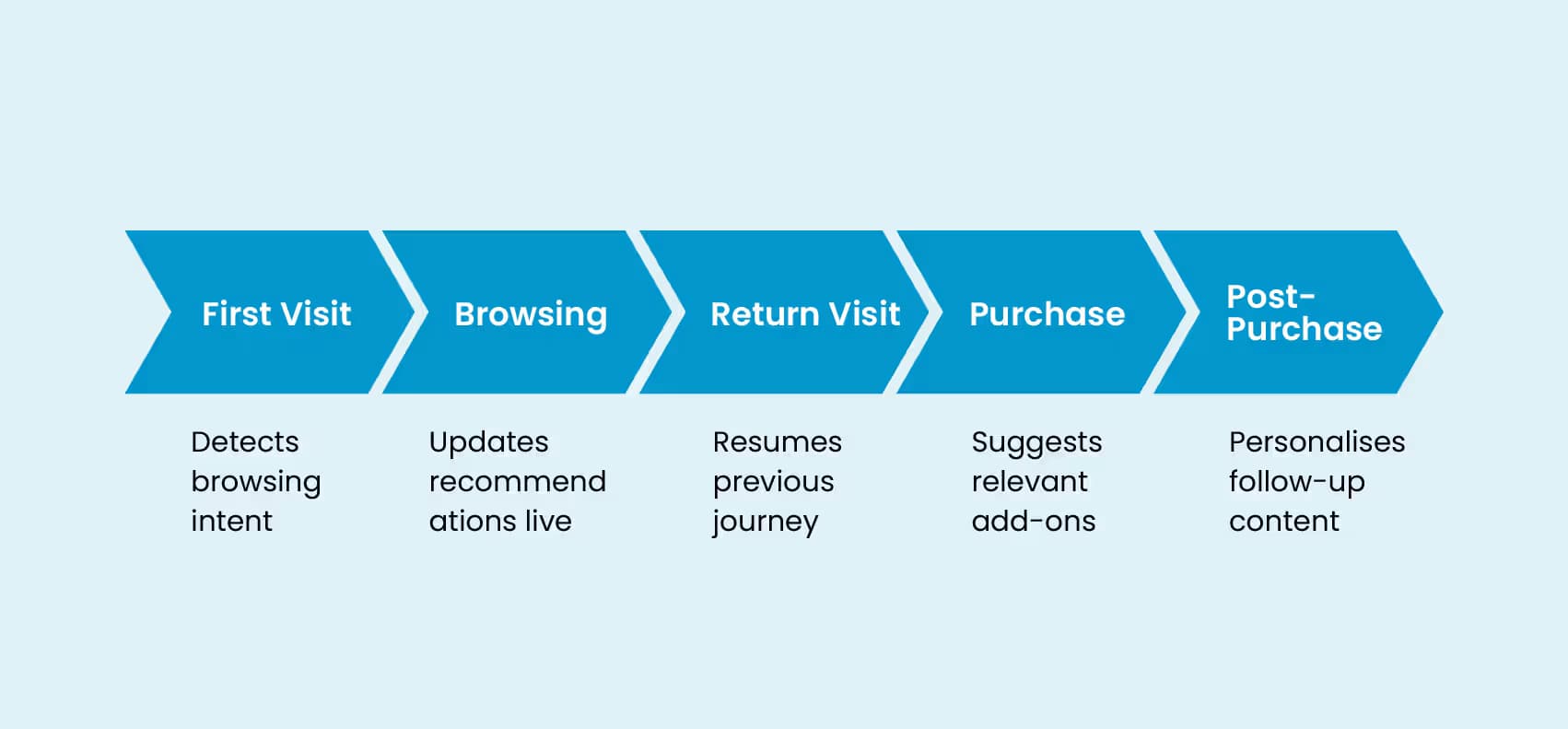
| Journey Stage | Traditional Personalization | With Customer Intelligence |
|---|---|---|
| First Visit | Customer sees generic bestsellers based on broad category rules. | Customer sees products aligned to browsing intent (running shoes, price range, use case). |
| Browsing | Same recommendations repeat across pages. No adjustment. | Recommendations update as behaviour changes (filters used, products compared). |
| Exit Without Purchase | A generic retargeting ad is triggered the next day. | Engagement is delayed or adjusted based on the likelihood of returning organically. |
| Return Visit | Customer starts from scratch. No memory of past intent. | Journey continues where it left off with relevant suggestions and context. |
| Cart Hesitation | Static discount rule fires for all users after X minutes. | Decision adapts based on intent signals. Some users see reassurance, not discounts. |
| Post-Purchase | Same cross-sell email sent to everyone. | Follow-up is personalized based on purchase context and future intent. |
TechMonk: The Best AI Agent Platform for E-commerce

TechMonk helps you build strong AI capital by bringing AI powered solutions into your customer engagement plans. You may wonder how this gives you a better view of each customer. TechMonk uses deep customer intelligence to create a complete view of customer behaviour and intent. This helps you design personal experiences and build loyalty at every step.
With advanced AI agents and smart workflows, TechMonk helps you increase customer lifetime value. It reaches the right customers with the right offers and improves every interaction. This supports steady and long term growth.
Pre-Built AI Agents for E-commerce Workflows
TechMonk offers ready AI agents that handle key tasks and help increase customer lifetime value across many sectors.
- AI Sales Agent: The AI Sales Agent works like a trusted sales guide. It studies customer actions and guides them to products they like. It shares personal suggestions and creates a smooth buying flow. This improves conversions and encourages repeat purchases. AI Sales Agent
- AI Support Agent: The AI Support Agent delivers fast and accurate support. It answers questions, resolves issues, and guides customers through self service. This reduces effort for your teams and improves the overall experience. AI Support Agent
- Voice AI Agents: The Voice AI Agent enables natural conversations across calls and messaging apps like WhatsApp. It follows your brand tone and offers full day support. It builds frequent engagement and stronger customer relationships. Voice AI Agents
Want to Build an AI Agent for Unique Needs
When ready agents do not meet all your needs, you can use TechMonk's Agent Builder, AgentMonk, to create custom AI agents. You design them to match your workflows, tasks, and goals. You may ask how simple this process is. TechMonk provides clear tools to help you get started.
- Tools Library: TechMonk offers a ready set of tools that you can use right away. You can also create your own tools when needed. These tools allow AI agents to take real actions like raising tickets or completing requests.

- Agents Library: You can explore a wide range of ready AI agents for different engagement needs. When you need something more specific, you can create an agent that fits your brand and purpose.

- Agent Flow: TechMonk connects all your AI agents into one smooth system. It assigns the right agent to each task and keeps responses fast, accurate, and relevant.
How TechMonk Ensures Your AI Agents Perform The Best
TechMonk supports your AI agents with strong features that keep them safe, accurate, and reliable. You may wonder how this level of control stays consistent as scale grows. Here is how TechMonk manages it.
- Guardrails: Guardrails keep AI agents focused on safe and correct responses. They block harmful replies and protect systems from prompt attacks. This keeps every conversation secure.
- Observability: You can watch AI agents in real time. You see how they respond and manage different scenarios. This helps you identify improvements quickly.
- Traceability: TechMonk logs every action taken by AI agents. You gain clear visibility and can study response patterns to improve outcomes.
- Tracking AI Agent Performance: TechMonk provides detailed analytics to measure performance. You can refine responses and improve accuracy with confidence.
- Testing Automation: Automated testing helps you test AI agents before launch. It detects issues early and ensures agents perform exactly as expected.
Want to Build AI Agents in Just 3 Steps?
- Choose Prebuilt Tools or Build Custom Tools
- Choose Prebuilt AI Agents or Custom AI Agents
- Build Custom Agentic Workflows to Automate Operations
Why TechMonk's AI Agents Are Unmatched?
TechMonk gives you a powerful customer engagement toolkit that supports its AI agents and delivers steady value over time. You may wonder what makes this approach work so well. TechMonk combines data, intelligence, and automation to help you improve customer lifetime value at every stage.
- Customer Intelligence Platform: With TechMonk, you get a complete view of your customers in one place. It brings together profiles, purchase behaviour, and engagement history. This helps you understand patterns and intent more clearly. You can then deliver personal and targeted experiences that keep customers engaged.
- AI-Driven Campaigns: TechMonk simplifies campaign management through clear AI driven automation. You can create personal offers for customer groups based on age, location, or behaviour. This helps you reach the right customers with the right message.
- Journey Builder: TechMonk simplifies campaign management through clear AI driven automation. You can create personal offers for customer groups based on age, location, or behaviour. This helps you reach the right customers with the right message.
Turn Cold Leads Into Loyal Customers And Increase LTV With TechMonk
Book DemoConclusion
Are you still using old personalisation methods that do not deliver results?
Building personalisation around AI-driven customer intelligence is no longer optional. It plays a critical role in how you engage, convert, and retain customers.
Without it, your personalisation efforts lose relevance, and customers quickly notice the gap. This is where the right platform makes a difference.
TechMonk helps you use real-time customer data to make smarter and adaptive decisions that improve conversions and loyalty.
Looking to shift from guesswork to insight-led actions? Book a call with TechMonk and see how customer intelligence can reshape your customer experience.
Learn more about how TechMonk's AI agents can transform your online store.
Book DemoFrequently Asked Questions
Have another question? Please contact our team!
AI customer intelligence uses advanced algorithms to turn customer data into clear and useful insights. It helps you understand customer behaviour and predict what they may need next. You may ask how this helps with day-to-day decisions. It supports real-time and personalised actions that improve the overall shopping experience.