Agentic AI: How Autonomous Systems Learn and Evolve
Key Highlights
What an AI Agent is: An autonomous software system that can independently create, execute, and refine an action plan to achieve a specific goal.
The Standard Loop: Most agents operate on a repeatable cycle of perception, decision-making, and action, but their core logic is often static.
Self-Evolving Agents: Unlike static agents, self-evolving systems can observe outcomes and modify their own operational logic to adapt and improve.
Key Architectural Difference: The primary distinction between agentic systems is whether they follow a fixed plan or can dynamically change their approach based on new information.
Most AI systems are reactive. A chatbot answers a prompt and waits for the next one. An image generator creates a picture and stops. A new class of system, however, is designed for proactivity. An agentic AI is an autonomous system that can perceive an environment, create a multi-step plan to achieve a goal, and execute that plan without continuous human input. While many agents can follow a plan, the most sophisticated ones can do more. They can observe their own performance, learn from their mistakes, and evolve their strategies over time. This post explains the architecture behind these self-evolving agents and how you can build systems that learn from experience.
What is an Agentic AI Agent?
An AI Agent is an autonomous software system designed to achieve a specific outcome. It operates by independently creating, executing, and refining its own action plan. Research from MIT Sloan defines this class of systems as being able to perceive, reason, and act within digital environments on behalf of a human principal.
So, what is agentic artificial intelligence in practice? The main distinction from other AI models is proactivity. A typical chatbot is reactive; it responds to a user's prompt and then waits for the next one. An AI Agent, by contrast, can monitor an environment, identify a goal, and initiate a multi-step workflow without being prompted. It takes the first step and every subsequent one.
To manage this kind of complex, sequential work, an agent's operational core must include memory. The system needs to retain context about its past actions and observations. This memory is what ensures a coherent workflow, allowing the agent to learn from previous steps and adjust its plan to successfully complete its objective.
To understand what makes an agent truly proactive, it is helpful to first look at its basic operational cycle.
The Standard Agentic Loop: From Prompt to Action
To understand how an agent evolves, we first need a baseline for how most agentic systems operate today. The majority of AI agents function on a consistent, repeatable cycle. This operational model is designed to take a complex user goal, break it down into manageable steps, and execute them sequentially until the objective is complete.
This process is often described as a continuous five-step loop. It begins when the agent receives a prompt or a goal. The agent uses its reasoning capabilities to construct a plan of action. Then, it executes the first step in that plan, which might involve using a specific tool or accessing a data source. After taking action, the agent observes the outcome to determine if the step was successful.
The final step is a 'Learn' phase where the agent reflects on the result of its action. This capacity for reflection is a key distinction from more rigid automation systems like RPA. If a planned step fails, the agent can stop, assess the failure, and generate a new plan to adapt its approach. This entire loop repeats, with the agent acting, observing, and learning until the initial prompt is fulfilled.
While this loop allows an agent to handle variability and recover from errors within a single task, the agent itself does not change between tasks. It begins each new assignment with the same initial architecture and knowledge, applying its loop-based process from a clean slate.
Beyond the Loop: Self-Evolution Through Observation

A standard software agent operates on a loop. It perceives its environment, makes a decision based on its programming, and executes an action. This cycle is consistent, but the agent's core logic is often static. Self Evolving Agents break from this fixed model by adding a crucial layer to the process: introspection. They don’t just perform tasks; they analyze their own performance to get better. This ability to learn from experience and modify their own behavior is the fundamental distinction. This is not about simply logging errors for a developer to fix. It is about the agent itself initiating a change in its future actions.
The mechanism for this evolution is grounded in a constant feedback loop. After executing a task, an agentic system evaluates the outcome. It assesses whether the action moved it closer to its objective or created an unexpected result. This evaluation serves as direct feedback, which the agent uses to inform its next decision. This core trait of adaptability is a defining feature of these systems. An agent might start with a general strategy for a task, but through direct interaction and feedback, it can refine or completely change its plan based on what it has learned. This is a departure from systems that require manual updates to handle new scenarios.
This capacity for self-correction is enabled by a process called reflection. Reflection is the agent’s method for analyzing its own work. It observes the result of an action, compares that result to the original goal, and determines if there was a discrepancy. If the outcome was not ideal, the agent adjusts its internal models or plans to improve its chances of success on the next attempt. This cycle of action, observation, and adjustment forms the basis of continuous learning. Over time, through methods like reinforcement learning, an agent methodically refines its strategies, becoming more effective at accomplishing its designated tasks.
When you build with this architecture, you are creating systems that can manage dynamic environments. Instead of deploying a tool that degrades in performance as conditions change, you can run an agent that adapts. Consider an agent designed to manage cloud infrastructure costs. It might initially follow a simple set of rules for scaling resources. But by observing spending patterns and application performance over time, it can learn more complex correlations. It can then adjust its scaling strategy to anticipate demand spikes it has seen before, optimizing costs more effectively than its initial programming allowed. The system measures its own success against its goal and evolves its approach accordingly.
This requires an infrastructure that can capture and process operational feedback.
How TechMonk Enables Agentic Self-Correction
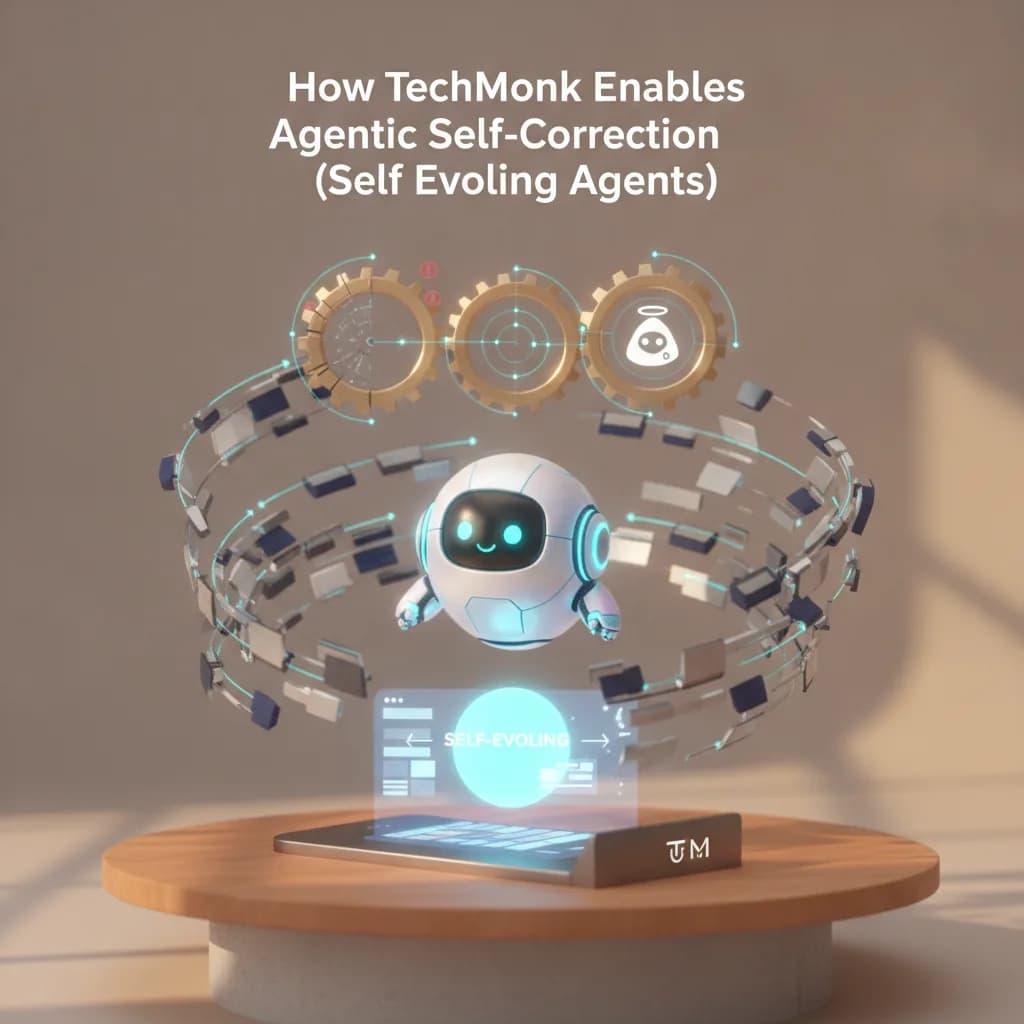
An agentic system's value is tied to its ability to adapt. When a plan fails or a process proves inefficient, the agent must be able to stop, reflect, and create a new approach. TechMonk provides the foundational components to build this self-correction capability directly into your automations, moving them beyond static scripts into dynamic workflows.
The process is built on a foundation of detailed observability. Every action taken by TechMonk Agents is recorded in a structured, queryable execution log. This log captures the inputs, outputs, tool usage, latency, and final outcomes for each step in a task. You can build agents that treat this execution log as a primary data source for reflection. When an agent completes a task, or hits a designated failure point, a separate analysis process can be triggered. This lets the agent programmatically review its own performance history against success criteria that you define.
This analysis is where agentic self-correction occurs. By reviewing the logged data, an agent can identify the specific tool call that failed, the logical branch that led to a suboptimal result, or a pattern of repeated, unnecessary steps. For example, an agent might learn that a particular data-fetching strategy consistently times out and decide to use a different endpoint or a caching layer in future runs. Based on this analysis, it can modify its internal plan or update a shared knowledge base for the next time it encounters a similar task. This ability for agents to learn from experience and adjust their behavior is fundamental to building systems that improve over time.
Within the TechMonk platform, you define the guardrails for this entire feedback loop. You control the conditions under which an agent can modify its own logic, the extent of those modifications, and the approval gates required for significant changes. With the right operational controls, you can construct agentic systems designed for continuous improvement, allowing them to refine their own workflows based on direct operational feedback.
Comparing Architectures: Static vs. Evolving Agentic Systems
Most agentic systems available today fall into one of two architectural categories: static or evolving. The distinction lies in how they respond to unexpected changes and new information. While both types of AI agents can automate tasks, their underlying designs determine their long-term effectiveness and the amount of manual oversight they require.
Many competitors build their agentic systems on a static model. These AI agents operate like advanced instruction-followers. They are given a defined process or a set of rules and execute it reliably, as long as the environment remains predictable. The problem arises when something changes, like a website UI update or an API modification. A static agent will likely fail and require a developer to intervene, diagnose the issue, and rewrite the instructions. This approach is brittle and creates a continuous maintenance cycle.
Evolving agentic systems operate on a different principle. Instead of just following instructions, they are designed to achieve an outcome. Many of these systems use reinforcement learning, a method focused on maximizing a reward function. When an evolving agent encounters an obstacle or a failed step, it doesn't just stop. It has the capacity to pause, reflect on the failure, create a new plan, and adapt its approach to overcome the problem. This is a fundamental shift from simply executing a script to actively problem-solving.
For those building with AI agents, this architectural difference has direct consequences. A static system requires you to build and then constantly rebuild. An evolving system allows you to build, deploy, and then measure performance as the agent learns and improves on its own. It handles variability without constant human intervention, leading to a more resilient and autonomous operation.
Building Autonomous Workflows with Agents That Learn
Organizations deploy AI agents for one of two reasons: to make higher-quality decisions than a person could, or to make decisions of similar quality for a fraction of the cost and effort. This principle, described in research by John Horton and Peyman Shahidi, is the foundation for building more effective systems. By 2023, a survey by MIT Sloan Management Review and Boston Consulting Group found that 35% of responding organizations had already adopted AI agents to pursue these outcomes.
When an agent can learn from its interactions, the systems you build on top of it become more resilient. Consider a Sales Automation workflow. A static agent can qualify a lead based on a fixed script. An agent that evolves can identify patterns in successful qualifications and adjust its approach over time, improving its accuracy without manual intervention. The same applies to support. An agent integrated with helpdesk software solutions can learn which troubleshooting steps are most effective for new issues, refining the customer journey for everyone who follows.
This capacity for self-improvement directly addresses the primary operational cost of AI. In one implementation studied by MIT Sloan professor Kate Kellogg, 80% of the work involved data engineering, stakeholder alignment, governance, and workflow integration. Building with agents that learn reduces the long-term burden of this integration work. Instead of constantly re-engineering data pipelines and workflows to account for new information, you can build systems that adapt. This allows you to construct more complex, multi-step processes with confidence, knowing the underlying agent will optimize its own performance as it runs.
The Future of Autonomous Systems and Their Considerations
The development of self-evolving agents marks a significant step in the field of autonomous systems. As these systems gain the capacity to modify their own operational logic, they open up new possibilities for complex problem-solving. This same capacity, however, introduces a new class of operational and ethical considerations. The core challenge is not just building these agents, but also ensuring they operate predictably and safely once deployed.
One primary concern is the potential for unintended behavioral drift. Some agentic AI systems can become self-reinforcing, a dynamic which may escalate their behaviors in an unintended direction. For autonomous systems managing critical infrastructure or financial transactions, such emergent behaviors present a tangible risk. Planning for these scenarios requires new approaches to monitoring, validation, and intervention.
On a broader scale, the societal implications of deploying agentic AI at scale are still largely unknown. MIT professor Sinan Aral describes our collective understanding of these effects as "nascent, if not nonexistent." This gap in understanding highlights the need for careful, measured deployment and ongoing research into the long-term effects of these technologies. As we move forward, the conversation must expand beyond technical implementation to include frameworks for governance and public trust.
FAQ
Have another question? Please contact our team!
Agentic AI works using a continuous loop. The agent receives a goal, uses its reasoning capabilities to create a plan, executes the first step, and then observes the outcome. It uses this observation to learn and reflect, adjusting its plan as needed. This cycle of planning, acting, observing, and learning repeats until the goal is achieved.
Conclusion
TechMonk provides the infrastructure for building these feedback loops. With detailed execution logs and programmatic controls, you can construct agentic systems designed for continuous improvement.
Explore the docs to get started