AI Chatbots for E-commerce Use Cases & Examples
Key Highlights
AI Chatbot Meaning: Software that converses with customers using human language to answer queries, assist shopping, and personalise experiences.
Chatbot Types: Website, social media, and messaging app bots supporting discovery, support, and engagement.
Chatbots vs AI Agents: Rule-based responses versus context-aware systems that learn, act, and execute tasks autonomously.
Business Benefits: Always-on support, automation, personalisation, multilingual service, and consistent cross-channel experiences.
E-commerce Use: Service, product discovery, order management, sales growth, loyalty, and two-way conversational marketing.
Are your customer conversations still slow and limited?
E-commerce brands now need faster and smarter ways to engage shoppers. Old chatbots could only give fixed replies. They often failed to help users properly. Today, AI agents are much more capable. They talk naturally, answer questions, and share product suggestions. They also help teams save time by handling support tasks.
Here are a few numbers to note:
- use generative AI in marketing
- 37% are actively rolling it out
This shift shows how fast things are changing. AI chatbots now manage tickets and pass only complex issues to humans.
This blog explains why AI chatbots matter today and how they can improve support, engagement, and overall business growth.
What is an AI Chatbot?
An AI chatbot is a AI program that can interact with customers through different platforms. For instance, it can assist customers through e-commerce websites, social media, and messaging apps. It can answer your customers in human language and even help them shop by offering them personalised recommendations and discounts.
Early chatbots were simple and followed some rules. They used "if-then" logic and looked for keywords in customer questions to give set answers. Now, AI agents-powered chatbot advances like Natural Language Processing (NLP) and Natural Language Understanding (NLU) help modern chatbots understand questions better. This allows them to have more dynamic conversations and detect customer emotions.
Today, e-commerce businesses use many types of chatbots for customer engagement.
Types of E-commerce Chatbots
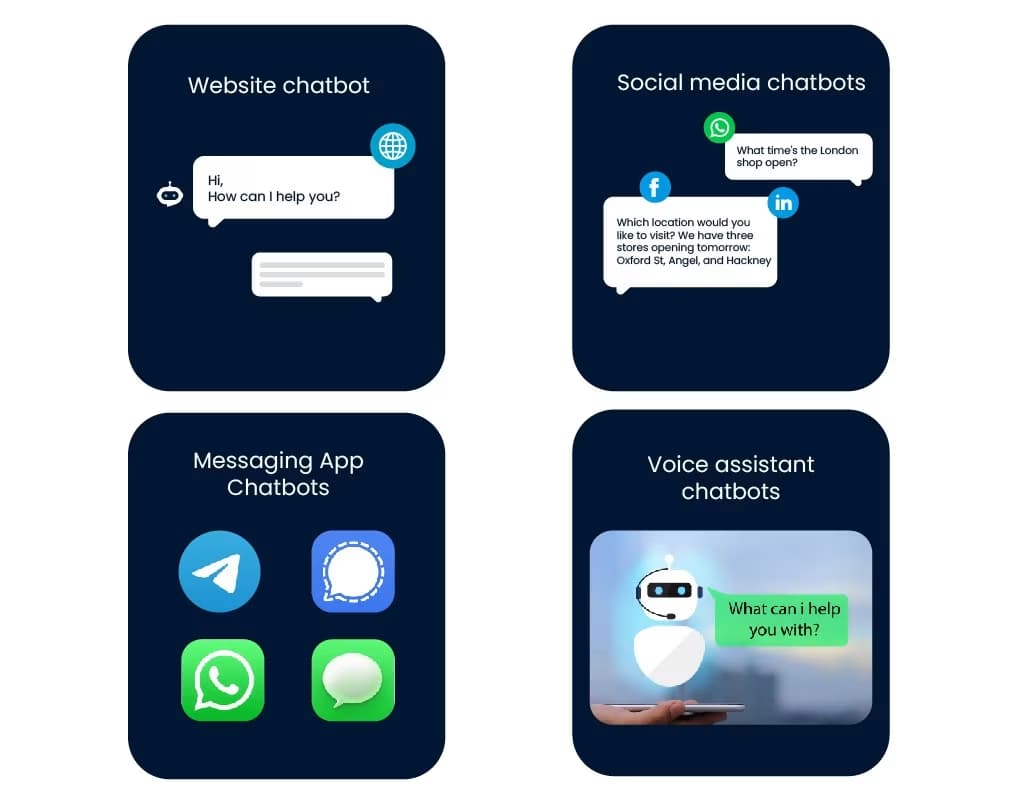
- Website Chatbots: Website chatbots engage with customers visiting an e-commerce website. These customers usually seek an assistant for product discovery or order tracking. These bots can provide detailed responses to basic inquiries, ensuring strong frontline customer support.
- Social Media Chatbots: E-commerce businesses can offer support beyond their websites. They can help customers on social media platforms like Facebook, Twitter, and Instagram. Chatbots can answer customer questions. They can suggest products and also share promotions.
- Messaging App Chatbots: Do you know that WhatsApp boasts almost 3 billion unique active users worldwide? Messaging app chatbots let you contact your customers on WhatsApp and similar services and offer competent assistance. They make your customer interactions feel more like talking to a friend to them rather than a business transaction.
AI Chatbots and AI-Agent-powered Chatbots (AI Agents)
| Feature | AI Chatbot | AI Agents |
|---|---|---|
| Functionality | Handles basic queries and FAQs | Handles complex tasks and supports decision-making |
| Customer Interaction | Text-based, often scripted | Context-aware, dynamic conversations |
| Learning Capability | Limited, relies on predefined rules | Learns from user data and adapts |
| Task Execution | Directs to resources, limited actions | Executes tasks, such as ticketing, order tracking, and recommendations |
| Best For | Simple customer support | Personalized, complex customer engagement at scale |
Benefits of AI Chatbots in E-commerce
 24/7 Customer
Assistance
Cross-ChannelCommunication
AutomatesRoutine Tasks
PersonalisedExperience
Multi-LingualSupport
AI Chatbots Customer Service
AI agents-powered chatbots can handle customer queries without interruptions and offer assistance without delay. Therefore, you can be available 24/7 to offer efficient assistance to all your customers. In other words, they can cover for human agents during off-hours.
Cross-Channel Communication
E-commerce customers expect a consistent and cohesive experience across all touchpoints. AI chatbots can integrate with different systems, such as an e-commerce platform, social media accounts, CRM software, etc.
They then gather data from all these sources to maintain the context of the conversation without needing the customer to explain it. For example, if a customer starts their interaction on a social media platform and then moves to a messaging app, a chatbot can easily pick up the conversation without the customer repeating it.
Automates Routine Tasks
An AI agents-powered chatbot in e-commerce can automate routine tasks like handling customer queries, offering uninterrupted support, and processing orders. Therefore, human agents can work with complex issues that require critical thinking. This streamlines the operations of e-commerce websites and even cuts down operational costs.
Personalised Experience
AI chatbots can help you offer a personalised experience to your customers. They can personalise communications across channels and suggest product recommendations to your customers.
Multi-Lingual Support
E-commerce businesses' customer base might not always be well-versed in English. Therefore, it is important for them to ensure that they can offer customer support in other languages as well. AI chatbots make this possible by providing support in different languages from across the globe.
Tired of repetitive support tasks? TechMonk automates ticket generation, order updates, and FAQs.
Try Techmonk6 Use Cases Of E-commerce AI Agents-Powered Chatbots
AI chatbots have different use cases for businesses. Here's the result of a survey conducted in the United States on how customers would use a chatbot if it were available.
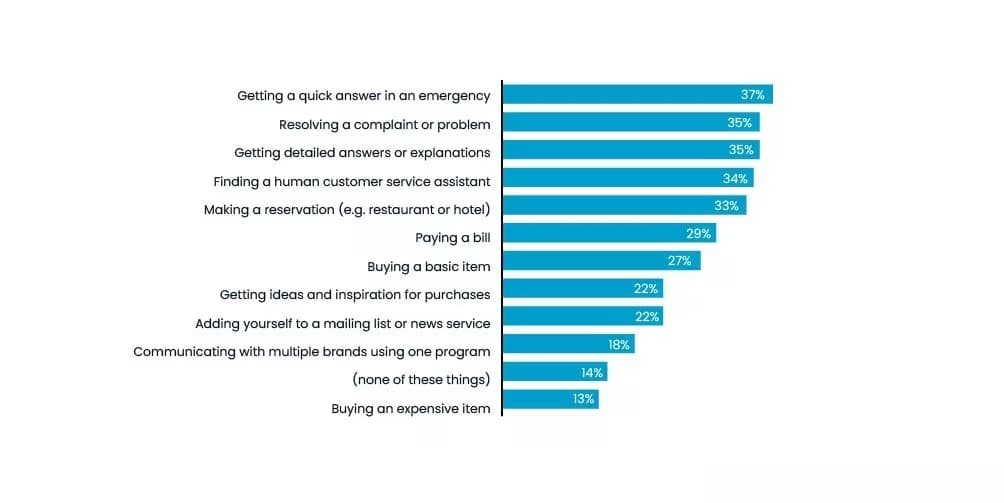
1. Customer Service Agent
If a business is known to offer good customer service experiences, then 68 per cent of customers are willing to pay more for their products. Therefore, impressing your customers with exceptional AI customer service brings in more revenue.
AI chatbots in e-commerce ensure uninterrupted customer service is available 24/7. Moreover, they give accurate and consistent responses to customers across different channels. They can effortlessly respond to frequently asked questions and guide your customers through the sales process.
2. Assist Product Discovery
E-commerce chatbots also provide personal shopping assistance for your customers. They engage with your customers in an interactive way, helping them find products through personalised recommendations. It can also compare similar products to help customers understand them better. As a result, e-commerce customers can make purchase decisions effortlessly.
For example, consider a beauty brand using AI agents as a shopping assistant. The bot interacts with customers in a personalised way, offering beauty recommendations and skin care tips that align with their preferences. It can use AR technology that lets customers virtually try on different makeup looks to be more sure of the products that they purchase online.
3. Managing Returns & Orders
E-commerce chatbots can give your customers real-time updates on their orders. They can also notify them of expected delivery schedules and related updates. In addition, chatbots can help customers return, cancel, and replace orders.
4. Gather Customer Information & Feedback
An e-commerce chatbot can collect customer feedback. It can use surveys, polls, and rating systems. This helps a business understand customer opinions on products before and after purchase. It also shows if customers are happy and if they would recommend the business.
With this feedback, businesses can see areas for improvement. They can use an AI chatbot to catch negative comments early. This way, businesses can fix issues before negative comments are posted online.
5. Promotes Sales & Discounts
Discounts and timely promotions are essential for any e-commerce business to drive more sales. Intelligent AI agent-powered bots can analyse a customer's past purchases, preferences, and browsing behaviour. This data lets them personalise the offers to align with the customer's requirements. Sharing these promotions with your customers increases sales for your E-Commerce business.
Consider a beauty brand with an AI chatbot. The chatbot would look into the customer's preferences and give them personalised discounts on products that they are interested in. This would improve the chances of the customer completing the purchase from the beauty brand.
6. Upsell & Cross-Sell
An AI chatbot is also an efficient tool for e-commerce businesses to upsell and cross-sell products with customers. They can suggest complementary products to customers during a purchase or inform them of special offers that would suit their purchase.
Businesses can also use AI chatbots to remind customers of abandoned shopping carts. Offering them special discounts on the items in the cart can also help reduce the abandonment rate.
7. 2-Way Conversational Campaigns
Today, most campaigns are one-way, with no interactive communication between the customer and the business. However, with today's AI agent-powered chatbot, e-commerce businesses can answer their customers' queries in real-time, answering their questions and giving them personalised offers.
With two-way conversational campaigns, you can meet customers' expectations, making their experience convenient and offering satisfying customer service through different channels. This increases the impact of your marketing efforts and deepens customer relationships over time.
Best AI Chatbots in E-commerce Examples
Here are the top AI chatbots example in e-commerce.
1. H&M: Virtual Stylist
H&M is an important clothing retailer that has a noteworthy chatbot on its website that acts as a virtual stylist. The chatbot keeps itself updated with customers' needs through a short quiz with pictures sent to customers.
It uses the data from the quiz to offer personalised suggestions to meet customers' interests. This saves customers time as they don't have to browse through different products.
In addition, the chatbot remembers the customers' preferences for future interactions. Moreover, it retargets the customers with more suggestions they might like.
2. Kiehl's: Facebook Messenger Bot
Kiehl's is a beloved cosmetics brand with a fantastic AI chatbot on the Facebook Messenger app. This messaging app chatbot acts as a recommendation engine and customer service agent. It assists users while they search for cosmetics based on product types and skin concerns.
The social media messenger bot also personalises the customer experience. If new users of the platform are unsure which products would suit their interests, the bot can assist them. As a result, it drives sales and builds a happy customer base.
3. DeSerres: Personalized Suggestions
DeSerres is a well-known Canadian art and leisure supply chain company. Their website features a noteworthy e-commerce AI chatbot that effortlessly engages with an increasing number of customers across different channels.
The AI chatbot provides personalised product recommendations to customers. The chatbot also gathers information on customers' preferences. Then, it uses the data to recommend products and offers. Users can then proceed to purchase the item.
Why Are AI Agents Outperforming Traditional Chatbots in E-Commerce?
AI agents are advanced systems that go beyond traditional chatbots. While chatbots typically respond to simple, predefined customer queries, AI agents can understand context, learn from interactions, and perform complex tasks.
They use the best technologies, like Natural Language Processing (NLP), in addition to machine learning, to create dynamic conversations. This makes them more suitable for e-commerce, where customer needs are diverse and ever-evolving.
E-commerce businesses are increasingly adopting AI agents because they can handle everything from product recommendations and upselling to order management and customer support, all while offering a personalised experience. This helps businesses improve efficiency, enhance customer satisfaction, and ultimately increase sales.
Here's a quick comparison of AI chatbots vs. AI agents in e-commerce:
| Feature | AI Chatbot | AI Agents |
|---|---|---|
| Functionality | Handles basic queries and FAQs | Handles complex tasks and supports decision-making |
| Customer Interaction | Text-based, often scripted | Context-aware, dynamic conversations |
| Learning Capability | Limited, relies on predefined rules | Learns from user data and adapts |
| Task Execution | Directs to resources, limited actions | Executes tasks, such as ticketing, order tracking, and recommendations |
| Best For | Simple customer support | Personalized, complex customer engagement at scale |
Furnishka: From Showroom-Centric Retailer to Omni-Channel Powerhouse
Find out how TechMonk's omni-channel retail strategy, powered by AI agents, supercharged Furnishka.
- 60% Reduction in cost per store visit
- 1.25X visit-to-conversion rate improvement
- 18% Sales Cost to Revenue percentage
Offer Unified Customer Experience Across Channels With TechMonk's AI Agents

TechMonk is your AI agent-powered, complete customer engagement platform. It helps you build strong AI capital in a simple and scalable way.
You may wonder what AI capital really means. AI capital refers to a group of smart AI agents and software that work together to improve operations and customer experience. As systems grow more complex, how do you keep everything aligned and useful?
Today, commerce depends on both AI capital and human capital. TechMonk helps you bring the two together with ease. You use AI capital to support your teams and not replace them. This balance helps you automate routine work while your teams focus on deeper and more valuable tasks. When your teams spend more time on impact-focused work, your overall efficiency improves.
Looking for Pre-Build AI Agents?
With TechMonk, you add automation to any part of your workflow with ease. You choose ready agents or build your own based on your needs. As requirements change, how do you stay flexible without slowing teams down?
TechMonk's Pre-built AI Agents
TechMonk offers ready-to-use AI agents that handle daily work smoothly. You deploy them quickly and set them up without code or complex steps.
- AI Sales Agent: This agent engages customers as soon as they show interest. It shares personal recommendations and provides instant quotes. This helps customers decide faster and enjoy a smoother shopping journey. AI Sales Agent
- AI Support Agent: This agent supports customers all day across many channels. It answers common questions and raises tickets for issues that need attention. It also routes complex cases to human agents and keeps responses quick and accurate. AI Support Agent
- AI Voice Agents: These agents manage calls using natural and simple conversations. They answer common questions, book appointments, and qualify leads. They make every call feel smooth and easy. AI Voice Agents
Build Your Own Agents with AgentMonk
AgentMonk gives you a simple AI agent builder for business needs. You create, train, and deploy custom AI agents that match your workflows and goals. When flexibility matters, why settle for limits when you can build exactly what you need?
- Tools Library: You access a library of ready tools that help agents raise tickets and resolve customer needs. You also create your own tools when needed to support specific workflows.

- Agents Library: You choose from many ready AI agents designed for different use cases. When none match your needs, you build a custom agent that fits your workflow.

- Agent Flow: Agent Flow keeps all agents aligned within your agentic workflows. It assigns the right task to the right agent and keeps responses fast and consistent.
How TechMonk Ensures Your AI Agents Perform Seamlessly
TechMonk supports your AI agents with features that keep them safe, reliable, and improving over time.
- Strict Guardrails: You define clear input and output guardrails so your system accepts only valid inputs. This keeps responses accurate and prevents misuse. You also protect quality control and system integrity. As usage grows, how do you maintain trust at scale? You rely on guardrails to guide every response.
- Testing Automation: You use an LLM Judge to train and validate AI agent responses on a continuous basis. This ensures customers receive accurate and relevant answers every time. You also keep response quality consistent as volumes increase.
- Observability: You monitor AI agents as they handle customer queries in real time. This helps you spot issues early and improve interactions. When speed becomes critical, how do you refine experiences faster? You observe workflows closely and act quickly.
- Traceability: You track AI agent conversations across many channels to understand how responses take shape. This helps you identify gaps and maintain consistent communication.
- Tracking Performance: You evaluate AI agents based on reasoning quality, response speed, and delay. These insights help you improve efficiency and performance over time.
Provide instant and accurate replies, enhancing customer satisfaction with TechMonk's AI agents.
Book DemoTakeaway
AI chatbots are not a factor of the future, as most organisations are already successfully adopting and making the most of them. Still, you can expect AI chatbots to come with a lot more benefits and use cases that will make your customer journey even better in the future.
As of now, AI chatbots strengthen customer service and help e-commerce businesses personalise user experiences like never before. They can assist customers with discovering products and improve the purchasing experience as shopping assistants. AI chatbots can also manage returns and orders, saving time for both the support agents and the customers.
Frequently Asked Questions
Have another question? Please contact our team!
The best AI chatbot for e-commerce is TechMonk's Gen AI bot. It helps e-commerce businesses extend support to customers through e-mail and websites.
It is also an essential asset to WhatsApp commerce. It assists customers during product discovery, offers personalised recommendations, and answers their queries. It helps e-commerce businesses to let users complete their purchases on WhatsApp itself.